
Stages of child development. Advice for every parent.
What is important for every parent to understand so as not to miss the most precious time in a child’s life?

TIME IS IRREVOCABLE!
During the first year of a child’s life, 60-80% of the brain is formed, which he will use for the rest of his life; the foundations are laid on which all subsequent results of the child in life will depend.
A child learns about the world through physical experience, and the more correct mobility in the first years of life, the better and faster the child develops, the more his intellect develops, the smarter the baby becomes!
The earlier a child’s motor and sensory experiences begin, the more developed he will be. The easier it will be for him to learn and the more pleasure the learning process will bring him.
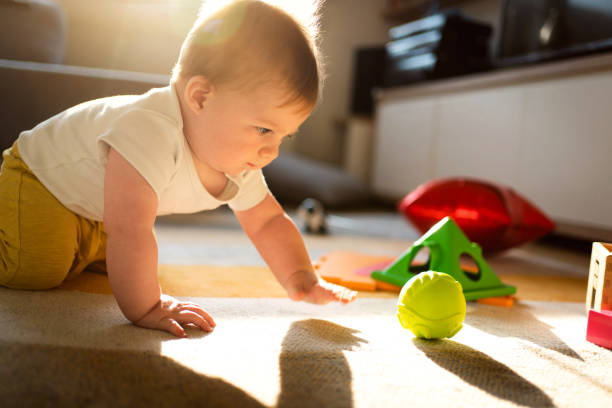
Did you know that up to 75% of the nutrients in every meal contribute to your baby’s brain development?
With every hug and kiss, with every nutritious meal, with every play, you help develop your child’s brain.
Here are some tips to help give your baby the best start in life:
- A few days after their birth, babies begin to smile in response to the smiles of others.
- Give your baby the opportunity to see, hear, move freely and touch you. You will see that the movements of your baby’s arms and legs are chaotic. Gradually, your baby will learn to control his body movements.
- Look into your baby’s eyes and smile back when he smiles. You will see your baby react positively to your facial expressions, movements and gestures.
- Talk to your baby in a soft voice, imitating baby talk. Both father and mother, as well as everyone who cares for the child, must communicate with the newborn. You will notice that the baby hears you and will soon begin to remember and copy your words.
- Gently change the tone of your voice. Speak slower/faster, quieter/louder, raise/lower your tone. Observe your baby’s facial expressions and movements and you will notice that he interacts with you.
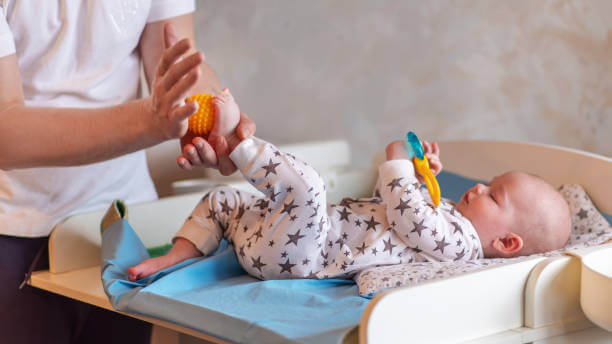
- Place your baby on his tummy and shake a rattle or ring a bell in front of him. Slowly move the rattle up so that the baby raises his head and shoulders and follows the movement of the toy with his eyes. This will help your baby follow the movement of the object and practice lifting the head and shoulders.
- Gently soothe, stroke and hold your baby in your arms. You will see how your child is comforted, he is glad that you are with him and cuddle him with you.
- Skin contact. The ability to feel and hear you and smell you will give your baby a feeling of calm and security.
Child care from 1 to 6 months
Children aged one to three months can best see objects located at a distance of 20-30 cm from them. By three months, children’s range of vision expands.

Give your baby the opportunity to see, hear, feel, move and touch you freely. Your child will gradually develop a sense of trust in you.
Move colored objects slowly so that your baby can see and reach them. A simple indoor toy, such as a rattle, can engage your baby’s interest in the sounds it makes.
Smile and laugh with your baby. Soon you will see how he will begin to smile back at you.
Talk to your baby and imitate his sounds or gestures. You will see how his gaze will gradually focus on your face, and he will try to imitate you.
Help your baby follow the object with his eyes. When he sees an object, slowly move it from side to side, up and down. You will notice how the child tries to follow the object with his eyes.
Help your baby reach a safe object. Take, for example, a plastic cup. You will see the child trying to grab or touch it.
Cut out simple pictures of familiar objects, people and animals. Try to make them different colors, different textures, depicting a variety of scenes and faces. Talk about the pictures when your baby looks at them. You will be able to observe how he listens to what you tell him and participates in this conversation in his own way.
Play with your baby. Place it on your tummy and slowly run your fingers down your back. Then quickly and gently tickle him, saying: “Here are my fingers, here they come, getting closer and closer to you.” To change the game, you can slowly or quickly run your fingers over the tummy and, after waiting a little, tickle the baby. You will see your baby express his delight by laughing or squealing.
Child care from 6 to 9 months
Starting from 6 months, you can begin to introduce complementary foods and introduce your child to foods that adults eat – vegetables, cereals, meat, dairy products.
When asking a question, give your child enough time to answer. Count to 10 to yourself. If there is no reaction, answer the question yourself. Try asking a simpler question next time.
Call your baby’s name as often as possible. He will look in the direction of the person calling and try to reach out to that person.
Never talk or sing too loudly, as this may frighten your baby.
Smile as often as possible to make your baby feel calm and confident.
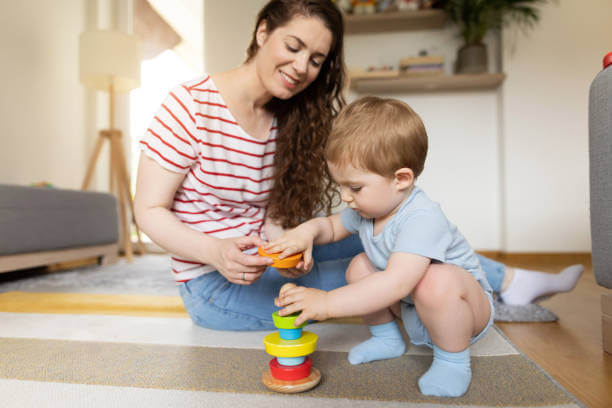
Give your baby clean, safe and colorful objects, such as a wooden spoon or plastic bowl, for her to reach, touch, hit or drop.
Use simple picture books, puzzles, puppets and other toys to develop your baby’s sense of curiosity and help him explore new things. To make a simple puzzle, simply glue a picture onto a piece of cardboard or other material and cut out sections.
Child care from 9 to 12 months
Kids are especially happy when they see that they bring joy to the adults around them.
Let your baby put things in and out of the box. He will try to pull them out and put them back himself. This is a great game for developing visual-motor skills.
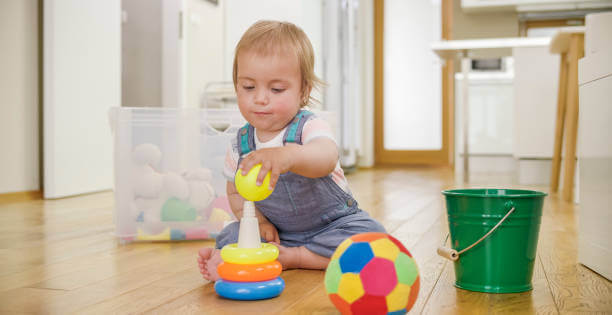
Let your baby stack objects or toys in a pyramid. He will try to pick up more objects on his own and make them fall, or he will try to stack toys until they fall on their own.
Ask your baby simple questions and respond to his attempts to speak. He will want to continue the conversation by answering and/or asking additional questions.
Try talking to your baby about different real-world objects, such as nature, pictures and objects in the environment. You will see your baby begin to move around, showing his readiness to explore his environment.
Watch what your baby does and name those actions: “You fill the box.” He will be happy to show you what he has learned and his self-esteem will increase.
Play with your baby and offer to help him: “Let’s do this together. There are more stones here that we will put in your box.” This will bring joy to the baby and give him self-confidence.
Take advantage of every opportunity to talk, including while feeding or bathing, or doing some work around your baby. Soon he will begin to understand what you are talking about and will be able to follow simple directions.
Turn simple questions into games: “Where is your toe?” or “Where is the bird?” You can look at the pictures and talk about what you see. The baby will begin to show more and more curiosity and a desire to report what he sees and hears.
Child care 2 years and older
Children perceive information better when they are taught how to behave well rather than when they are scolded for bad behavior.
Ask simple questions and listen to the answers. Encourage your baby to talk and answer questions like: “What is this?”, “Where is the window?”, “Which ball is bigger?”, “Do you want a red cup?” You will observe your baby’s growing interest in communicating with you and answering your questions.
Read stories to your child and ask questions about what you see in the book. You will notice that your baby remembers and tries to repeat what you read.
Help your little one learn to count by asking “how many?” and counting objects with him. At first, your baby will make mistakes, but after repeating the action many times, he will cope with the task.
Offer your little one different shapes, such as circles and other shapes cut out of colored paper, to compare and sort. He will be happy to try sorting shapes and will learn to combine and correlate different objects, colors and shapes.
*Sources: Steen, The Emerging Brain: Known and Unknown, 2007; Dekaban, Bulletin of Neurology, 1978


Hello, I’m Dorothy. I love writing and researching articles. Reading books about baby health, care and pregnancy are my favorite. I will be sharing delicious and healthy information on food and baby food during pregnancy.